Ride the world's only commercial magnetic levitating train
Discover serene parks with cats amid towering skyscrapers
Savor authentic hand-pulled noodles in bustling night markets
Marvel at China's most stunning illuminated waterfront skyline
 10 Hours duration
 Easy difficulty
 Maglev+Metro transport
 Walking shoes
 Low cost
 Busy crowds
Why We Love This Trip
Interactive Map
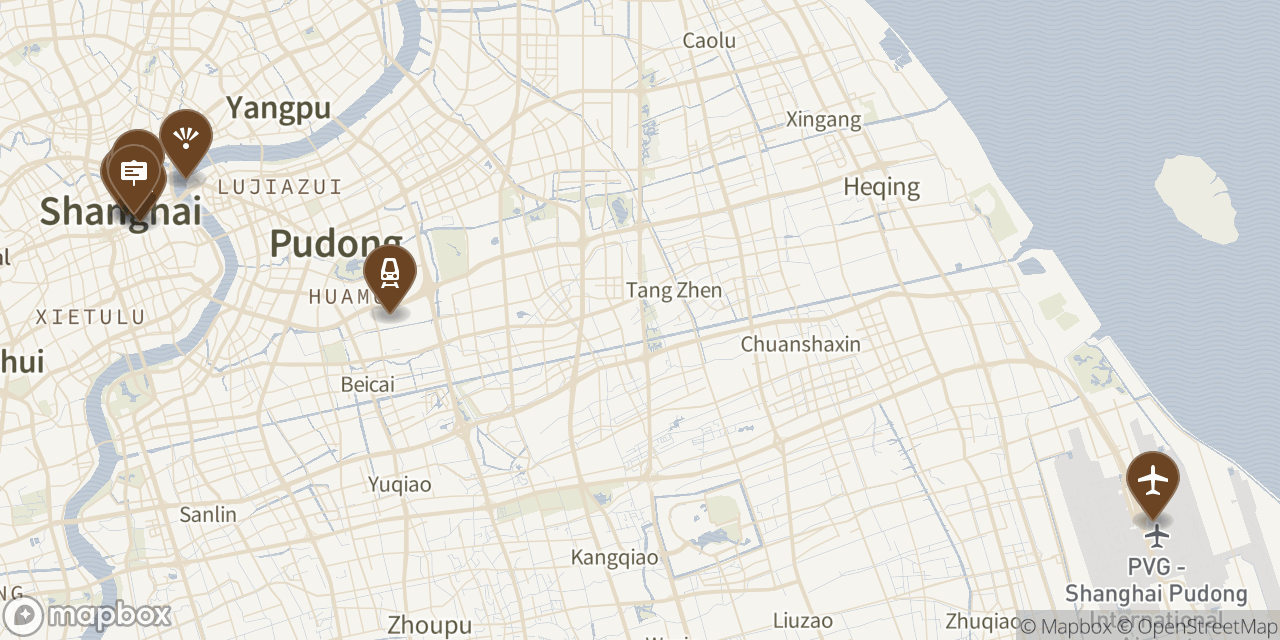
Points of Interest


Your Day Trip Timeline
Arrive at Shanghai Pudong International Airport
Apply for 72-hour visa-free transit pass at immigration - bring proof of onward flight
Ride the Maglev Train to Longyang Road Station
8-minute journey reaching 431 km/h, departs from airport - only commercial maglev in the world
Transfer to Shanghai Metro at Longyang Road
Use Apple Maps for navigation (Google doesn't work in China) - connect to city center lines
Explore People's Square and People's Park
Beautiful urban park with winding paths, fed cats, and locals practicing tai chi - perfect first stop
Visit Shanghai Museum exterior in People's Park
Closes at 5pm daily, shaped like ancient Chinese ding cooking vessel - stunning architecture worth seeing
Walk East Nanjing Road Pedestrian Street
Massive car-free shopping boulevard with food halls, arcades, tea shops - bring Alipay or WeChat Pay
Set up mobile payment before shopping
Credit cards rarely accepted, especially by younger vendors - Alipay or WeChat Pay essential for purchases
Experience the Bund waterfront at night
Shanghai's famous skyline viewing area - expect massive crowds but stunning illuminated views across the river
Find hand-pulled noodle restaurant near the Bund
Look for places making fresh noodles by hand - ask locals for help ordering, request spice level
Wander the Old Town jewelry quarter after dark
Beautiful architecture around 10:30pm with fewer crowds - stores closed but buildings still impressive
Return to airport via Metro and Maglev
Allow 90+ minutes for journey back - budget extra time for security and visa exit procedures
Ben's Deep Dive
Beyond the glittering towers lies a city where ancient engineering marvels meet ultra-modern innovation, and understanding Shanghai's unique transportation revolution and cultural spaces reveals why this megacity feels surprisingly different from other Asian metropolises.
Shanghai's transportation infrastructure represents one of the most ambitious urban experiments in modern history, and nowhere is this more apparent than in the magnetic levitation train connecting Pudong International Airport to the city center. Commissioned in 2004 as a joint venture between German engineering firm Transrapid and Chinese authorities, this 30-kilometer track remains the world's only commercially operating maglev system—a testament to both its engineering brilliance and its commercial limitations. The technology itself is remarkably straightforward: electromagnetic forces lift the train 10 millimeters above the guideway, eliminating friction and allowing speeds that would destroy conventional rail systems. At 431 kilometers per hour during peak operation, the journey compresses what would be a 45-minute drive into an 8-minute technological showcase. Yet despite its success, the maglev stands alone globally, a victim of its own expense—construction costs exceeded $1.2 billion for just 30 kilometers of track. The experience of riding this 20-year-old machine feels intentionally preserved, almost museum-like, similar to boarding the Concorde or experiencing other pinnacle technologies that proved too costly to replicate. The slight sway at top speed, the analog displays showing velocity in real-time, and the dated-yet-functional interior all contribute to the sensation of riding a piece of living engineering history rather than routine public transit.
The contrast between Shanghai's hyper-modern infrastructure and its commitment to traditional public spaces becomes immediately apparent at People's Park, where the city's frenetic energy dissolves into something remarkably serene. This central green space, surrounded by some of Asia's tallest skyscrapers, functions as a living museum of how Chinese urban culture balances progress with tradition. The practice of tai chi on ancient rocks isn't performed for tourists—it's genuine daily ritual, with practitioners arriving before dawn and continuing throughout the day, their slow, deliberate movements contrasting sharply with the perpetual motion of the surrounding city. The park's most unexpected feature might be its thriving cat population, not strays but genuinely cared-for animals with designated feeding stations and small shelters integrated into the landscape design. Counting 39 cats during a single afternoon visit reveals an intentional ecosystem where urban wildlife receives consideration typically reserved for formal exhibits. The vegetation itself grows thick enough to create genuine jungle-like corridors where the surrounding metropolis temporarily disappears, only to reappear through gaps in the foliage as a reminder of where you actually are. This intentional design philosophy—creating spaces where urbanites can completely escape mental awareness of the city while remaining in its geographic heart—represents a distinctly Chinese approach to urban planning that prioritizes psychological refuge as essential infrastructure.
What makes Shanghai genuinely different from other Asian megacities becomes apparent only after dark, when the eerily quiet streets reveal the city's wholesale embrace of electric vehicle technology. The absence of engine roar creates an almost unsettling soundscape where a bicycle bell registers as notably loud and crowds generate more ambient noise than six-lane arterial roads. This isn't selective pedestrianization or limited traffic zones—it's city-wide transformation. The electric vehicle adoption rate in Shanghai exceeds 50% of new vehicle sales, driven by aggressive government incentives including free license plates (conventional vehicle plates cost upward of $15,000 at auction) and preferential parking access. The result is a 25-million-person metropolis that somehow registers lower decibel levels in many districts than cities a fraction of its size. Yet this tranquility contrasts dramatically with spaces like the Bund waterfront, where the visual assault of coordinated LED displays covering dozens of skyscrapers, combined with massive crowds navigating viewing platforms, creates sensory overload of an entirely different variety. The skyline itself wraps around every bend of the Huangpu River, creating 360-degree panoramas where architectural statement pieces compete for attention—the Oriental Pearl Tower's distinctive spheres, the bottle-opener-shaped Shanghai World Financial Center, and the twisting Shanghai Tower all visible simultaneously. This juxtaposition—quiet streets giving way to overwhelming sensory destinations—defines Shanghai's personality as a city of intentional contrasts rather than consistent character.
The East Nanjing Pedestrian Walkway encapsulates this philosophy of controlled chaos, where a seemingly straightforward shopping street transforms into a multi-sensory experience featuring tea shops with proper tasting ceremonies, food halls that blur into gaming arcades, and storefronts where jewelry engravers work beside dragons pumping theatrical smoke into crowds. The challenge of payment systems—where younger staff may not recognize how to process chip cards and vendors expect Alipay or WeChat Pay exclusively—reveals how completely China's digital payment revolution has displaced traditional transactions, even for international tourists on brief visits. Yet beyond the commercial spectacle, authentic experiences persist in unmarked restaurants where hand-pulled noodles are crafted by masters who've perfected their technique over decades, where locals from Morocco and Kazakhstan help confused travelers order meals, and where the definition of "spicy" carries genuinely challenging heat. These moments of genuine connection, combined with bucket-list experiences like the maglev and world-class skyline views, demonstrate why even a 10-hour layover can deliver more memorable experiences than multi-day stays in cities that lack Shanghai's density of contrasts. The city doesn't reveal itself through extended contemplation—it overwhelms immediately, demanding return visits to process everything missed during that first intoxicating encounter.
Support Us
Plan Your Trip
Get personalized recommendations and custom itineraries for your Munich adventure. Whether you need help planning the perfect day trip, finding hidden gems, or creating a multi-day itinerary, we're here to make your Munich experience unforgettable.
| Consultation | Time |
|---|---|
| Quick Q&A | 20 min |
| Tailored Consultation | 45 min |
Join Our Tours
Experience Munich like a local with our personalized walking tours and full-day adventures! From hidden gems to local favorites, we'll show you the authentic side of Munich that most tourists miss.