Savor legendary cakes in stunning nineteenth-century cafés
Taste hearty goulash on crispy fried langos bread
Sip craft cocktails beneath glittering art nouveau ceilings
Raise a glass in historic ruin bars
 Easy difficulty
 Full Day duration
 Walking footwear
 Walking transport
 Medium cost
 Self-guided guide
Why We Love This Trip
Interactive Map
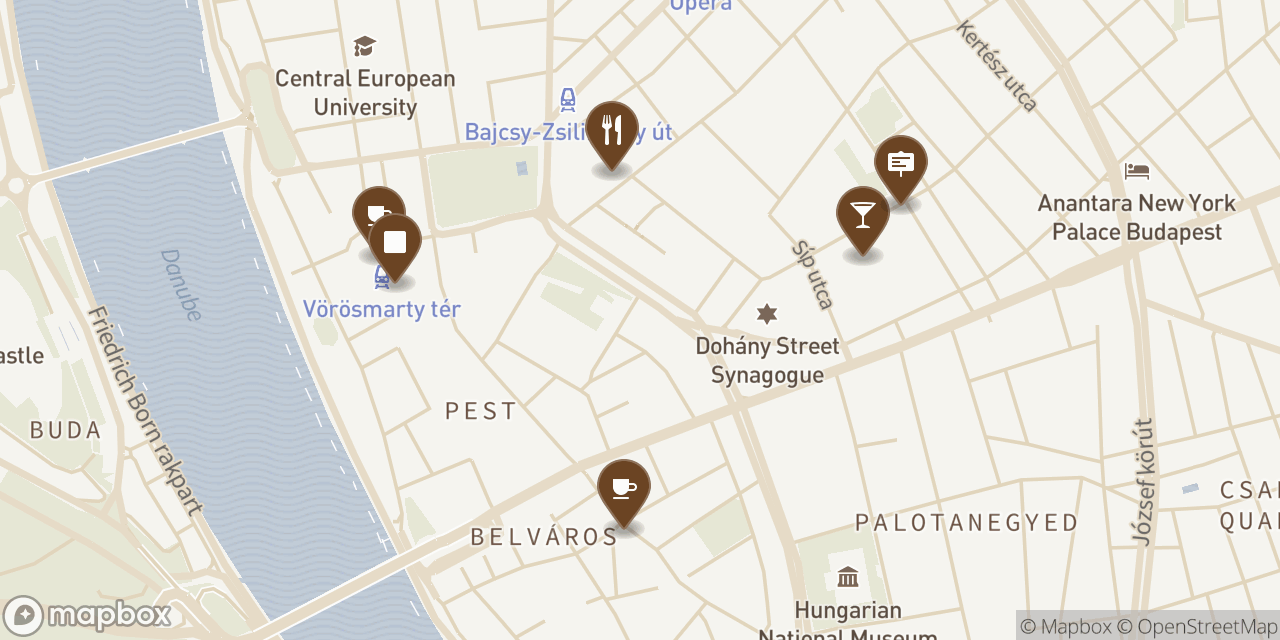
Points of Interest


Your Day Trip Timeline
Start at Café Gerbeaud in Vörösmarty Square
Founded 1858 by imperial confectioner, expensive but iconic - arrive early to avoid crowds
Order specialty coffee and Hungarian cake
Try Gerbeaud cake with walnut paste and apricot jam, or Dobos cake with chocolate-orange layers
Get traditional lángos for lunch
Fried dough with sour cream, mozzarella, and garlic sauce - fluffy inside, crispy outside, around 1,000 HUF
Try goulash on lángos combination
Elevated street food pairing beef stew with fried bread - perfect hearty winter dish at local restaurants
Sample chimney cake (kürtőskalács) on the street
Get original version with sugar and walnuts, skip touristy ice cream toppings - half the price, authentic experience
Visit Vegan Garden for white bean goulash
Traditional vegetarian goulash option, hearty and meaty texture - vegetarians can enjoy Hungarian cuisine too
Order Hungarian cream cake (krémes)
Flaky pastry layers with generous cream filling at reputable café - not overly sweet like American versions
Enjoy cocktails and desserts at Café Central
Art Nouveau café with live music, trio of Hungarian cakes recommended - touristy but excellent quality
Experience Szimpla Kert ruin bar in Jewish Quarter
Most famous ruin bar, mismatched furniture in crumbling courtyard - arrive evening for full atmosphere, draft beer around 800 HUF
Explore the ruin bar culture and history
Support local establishments to preserve community art spaces - check out multiple ruin bars beyond just Szimpla
Ben's Deep Dive
From imperial confectioners to communist-era decay turned artistic triumph, Budapest's culinary scene tells a story of resilience, creativity, and cultural preservation that stretches back centuries.
What makes Budapest's food culture truly exceptional isn't just the quality of its pastries or the richness of its soups—it's the layers of history baked into every bite. Café Gerbeaud, founded in 1858, wasn't simply another fashionable establishment; its founder held the prestigious title of imperial confectioner to the Austro-Hungarian Empire itself. This wasn't just about status—it meant access to the finest ingredients from across the empire's vast territories, from Adriatic hazelnuts to Carpathian walnuts, and the technical knowledge passed down through generations of royal kitchens. The café has survived two world wars, communist occupation, and the complete transformation of the city around it, yet it continues serving the same meticulously crafted cakes that once graced imperial tables. That continuity matters because it represents something deeper than nostalgia—it's a direct link to a vanished world where central European coffee culture rivaled the great salons of Paris and Vienna as centers of intellectual and artistic life.
The story of lángos reveals another fascinating dimension of Hungarian culinary tradition. While you'll encounter this fried dough across Central Europe—particularly at German and Austrian Christmas markets—the Hungarian version achieves something distinctly different. The secret lies in the dough preparation itself, which creates those characteristic huge air pockets and an impossibly chewy interior that somehow maintains perfect crispiness on the outside. This isn't accidental; it's the result of techniques refined over generations, likely originating as a way for Hungarian bakers to use leftover bread dough. What began as peasant food—simple, economical, filling—has evolved into an art form that ranges from street-corner vendors to upscale restaurants serving it alongside gulyás. Speaking of goulash, the revelation that it's not a single dish but rather a genre of hearty soups opens up the entire tradition. The white bean version, for instance, represents centuries of culinary adaptation, showing how Hungarian cooks created satisfying alternatives during times when meat was scarce or during religious fasting periods. This flexibility and creativity under constraint defines so much of Hungarian food culture.
But perhaps nothing embodies Budapest's spirit of resilience and creativity quite like the ruin bars of the Jewish Quarter. The neighborhood itself carries profound historical weight—forced to the city's outskirts during medieval times when Jews were prohibited from living within the walls, then deliberately ghettoized during the Nazi occupation, and finally left to decay during the Soviet era when the communist government simply abandoned entire buildings to rot. The very courtyard where Szimpla Kert now stands was scheduled for demolition, another victim of post-communist development schemes. Instead, local entrepreneurs transformed these crumbling spaces into something remarkable: eclectic art installations filled with mismatched furniture, each piece telling its own story of Budapest's past. This wasn't corporate placemaking or calculated nostalgia—it was genuine community response to adversity, turning urban decay into creative expression.
Yet this tradition now faces its own existential threat. As Budapest's city center expands and the once-peripheral Jewish Quarter becomes prime real estate, many ruin bars have been sold to development companies for conversion into hotels and restaurants, or transformed into more profitable dining establishments that sacrifice their community character for tourist euros. What began as authentic neighborhood gathering spaces risks becoming just another commodified experience, sanitized and packaged for mass consumption. This tension between preservation and profit, between authentic community culture and economic development, plays out in countless cities worldwide, but in Budapest it feels particularly poignant given everything these spaces represent. Supporting the remaining authentic ruin bars—even the touristy Szimpla Kert—becomes an act of cultural preservation, keeping alive spaces where locals and visitors alike can gather over draft lagers and appreciate art born from adversity rather than corporate boardrooms.
Support Us
Plan Your Trip
Get personalized recommendations and custom itineraries for your Munich adventure. Whether you need help planning the perfect day trip, finding hidden gems, or creating a multi-day itinerary, we're here to make your Munich experience unforgettable.
| Consultation | Time |
|---|---|
| Quick Q&A | 20 min |
| Tailored Consultation | 45 min |
Join Our Tours
Experience Munich like a local with our personalized walking tours and full-day adventures! From hidden gems to local favorites, we'll show you the authentic side of Munich that most tourists miss.